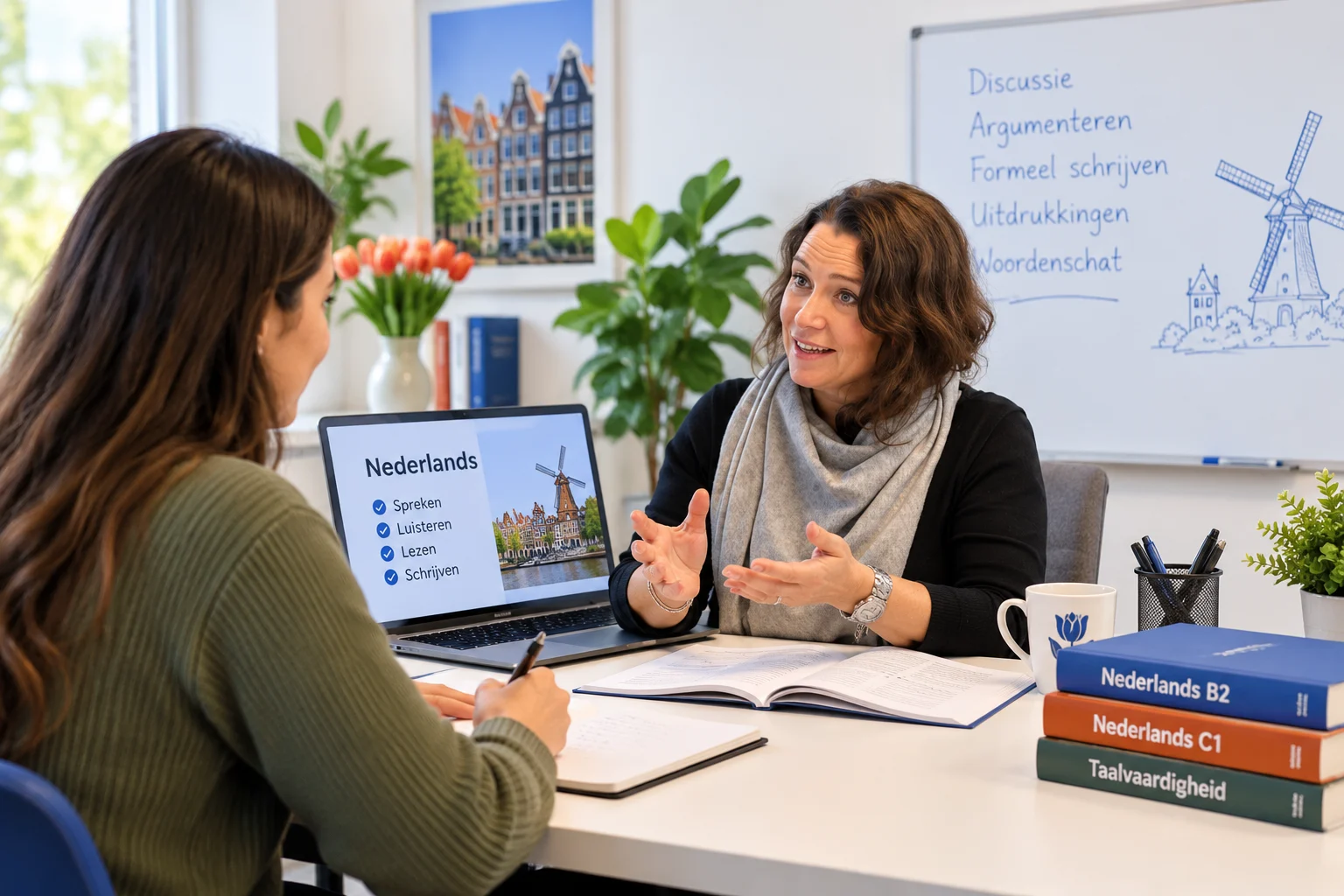
I’ll be direct with you. Advanced Dutch isn’t for everyone. And that’s okay.
In case your only aim is ordering groceries and getting acquainted with neighbors, B1 level will be just fine for you. In that case, no need to waste time and money on advanced Dutch language courses online.
However, if you want to establish a career in the Netherlands, study at a Dutch university, or fully integrate into Dutch society, then advanced Dutch becomes not an option but a necessity.
The question is: are you ready to make that commitment? Because advanced online Dutch language courses require effort, consistency, and knowing your ‘why I want to do this’.
At The Dutch Minds, we’ve already helped thousands of students to find answers to this question. Let me help you now too.
What Makes Dutch Language Courses Online “Advanced”
Before you decide whether advanced courses are for you, you must know what “advanced online Dutch language classes” are. They include B2 (upper intermediate) and C1 (advanced) levels.
Till B1, you learn to introduce yourself, have small talk, order something, write simple essays, and express basic opinions. But at B1, you’ll be able to interact with natives fluently, write professional documents or subject-specific topics, and learn complex Dutch for debates.
And at C2, you will have a strong command of the Dutch language, understand complex language, and use your skills for social, academic, and professional purposes.
Who Should Actually Consider Advanced Online Dutch Language Lessons
Advanced-level study is not suitable for everyone, and that’s perfectly okay. Here are signs you are ready for advanced levels:
- You can already have long conversations in Dutch without going back to English mid-conversation.
- Your goal is to use Dutch in your workplace environment, rather than just in small talk.
- You need to study at university, where all your subjects will be taught in Dutch.
- You need to understand sarcasm and humor, and not just translate word by word.
- You need help to get over your intermediate plateau.
If none of these sound like you, it doesn’t mean anything bad; it means you might still need intermediate-level Dutch language classes online.
Are you learning Dutch online for work? Here’s the only course you’ll ever need.
Does Work Actually Require Advanced Dutch?
This really depends on your field of business. There are plenty of international enterprises doing just fine with English, and intermediate Dutch will be enough for social life.
However, some industries like healthcare, law, education, governmental jobs, and many others do require B2-level proficiency or even higher, as precision and nuances play a far bigger role than comprehension of the basics here. If your career is connected to one of those, attending online Dutch language courses at an advanced level should be considered not just desirable, but inevitable.
The Jump from Intermediate to Advanced
This process normally takes much longer than expected, and it is quite natural. Progression from B1 to B2/C1 normally implies spending several hundred extra hours of studying, which is normally spread over 6 to 12 months or even more, depending on the speaking experience gained alongside.
The feeling of being stuck that many students experience around this point is very real — the active vocabulary grows, while grammatical mistakes become much more difficult to notice, which is why Dutch language courses online become even more important.
Practical Tips for Advanced Learners
- Listen to local Dutch content without subtitles – podcasts, movies, and conversations make your ear get used to native speed.
- Learn to write formally, not only conversationally – emails, essays, and arguments train another skill.
- Familiarize yourself with the differences in dialects – Flemish Dutch and different Dutch regional accents will make your listening skills stronger.
- Debate on topics you care about with your tutor or native speaker – it will help you prove your fluency in an abstract discussion.
- Don’t omit grammar lessons because you are an advanced learner – you will be prone to mistakes that will be hard to correct at this level.
Here is the complete guide to achieving Dutch fluency.
You’ve Come This Far. Don’t Stop Now!
Advanced Dutch may not be for everybody, but for you, if you are determined to have a bright future in the Netherlands. It opens all doors for you: career prospects, real relationships, a profound knowledge of culture, and a total readiness to face anything.
The Dutch Minds helped a lot of students go from an intermediate level to an advanced one, and our Online Dutch Language Classes are tailor-made for professionals and expats who wish to improve their Dutch.
Your Dutch journey doesn’t stop at “good enough.” It’s time to become truly fluent.
Frequently Asked Questions
People who can already communicate comfortably and need to learn nuances, professional vocabulary, or advanced language skills for business, studying, or other reasons.
At B2 level, you can use the language confidently and independently in all contexts, and C1 level requires near-native proficiency with nuance and tone.
It depends on your field of activity; in many international companies, intermediate Dutch suffices, but fields like healthcare, law, or education usually require B2 or above.
Idioms, writing, advanced grammar, debating, and regional accents are typical subjects studied at advanced levels.
The transition from B1 to B2 or C1 takes most people around 6 to 12 months.
Yes, usually, because the Dutch-taught university program normally requires B2 or C1 levels of proficiency.